For years, EFRIS was somebody else's headache. If you weren't registered for VAT, you carried on: a receipt book, a counter book, and a phone call to the accountant at the end of the month.
That ended on 1 July 2025. Under General Notice No. 2218 of 2025, gazetted on 25 July 2025 and signed by Commissioner General @John R. Musinguzi, twelve (12) more sectors must now issue EFRIS e-invoices and e-receipts whether or not they are registered for VAT. If you run a transport company, a guest house, a construction firm, a real estate agency, an ICT shop or a consultancy, you are in. Most business owners we talk to in Kampala still think this doesn't apply to them, it does!
The Counter Book and the Laptop

"Any process that asks a human to enter the same figure twice will eventually be entered once" - common sense?!
Here is what usually happens next;
The business registers on EFRIS because it has to then Someone in the office is handed the task. Now there are two systems: the sales are recorded where they have always been recorded, and then - separately, somebody logs into the EFRIS portal and types the same transaction again. For a few weeks, this could work.
Then a busy Friday comes, 20 invoices go out and only fourteen make it onto the portal. Nobody notices until the accountant asks for the reconciliation, three weeks later, and the numbers don't agree. This is not a discipline problem - It is a design problem. Any process that asks a human to enter the same figure twice will eventually be entered once.

URA has also said more sectors will follow in future notices
Who is caught now?
The twelve sectors named in the notice are broad on purpose. Read the list carefully "professional, scientific and technical activities" alone covers accountants, lawyers, engineers, surveyors, IT consultants and marketing firms. "Arts, entertainment and recreation" covers event companies and gyms. URA also confirmed that more sectors will follow in future notices. Planning on the assumption that you will "stay outside" the net is not a plan.
What Does Non-compliance Actually Costs?
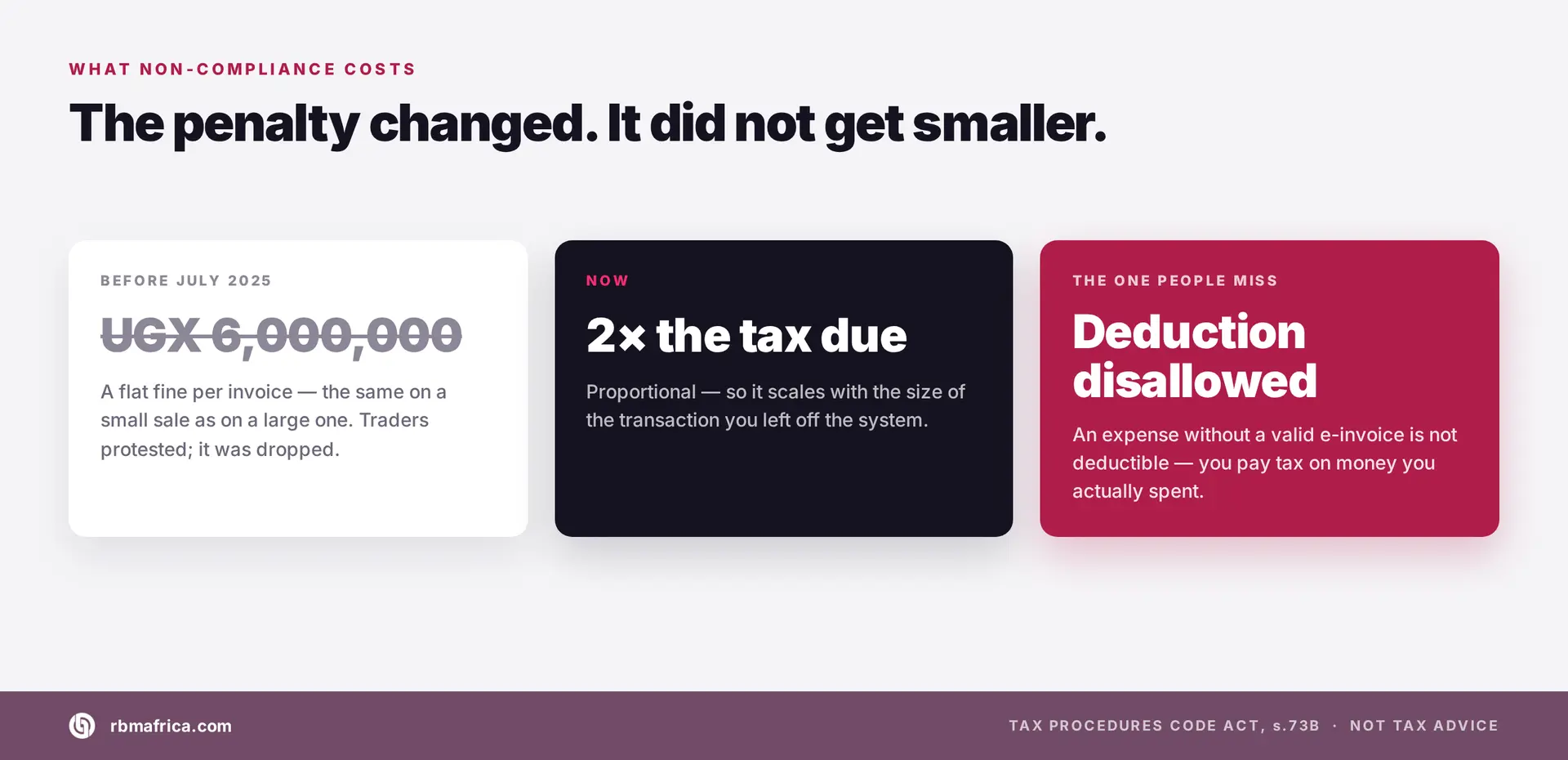
There is a widespread belief that the EFRIS penalty is UGX 6 million per invoice. That was true, and traders protested it hard; a flat fine applied the same way to a small sale and a large one. From July 2025 it was replaced with a penal tax of twice the tax due on the goods or services involved. Proportional, yes. Smaller, no - not once the transaction is large.
The part that gets missed is quieter and, for most businesses, more expensive: an expense supported by an invoice that should have been fiscalised but wasn't an allowable deduction. Your supplier's failure lands on your tax bill. You end up paying tax on money you genuinely spent. And the enforcement mood has changed. In July 2026 the High Court dismissed a judicial review by two company officers who argued URA should have prosecuted their company rather than them personally. The court held URA acted within its powers.
Whatever the merits of that particular case, the direction of travel is clear: URA is willing to go past the company name on the letterhead. The compliance gap is what's driving this. Ministry of Finance figures for FY 2024/25 show 106,093 taxpayers on the EFRIS VAT register but only 81,585 of them, about 77%, were actively issuing fiscalised receipts. Roughly one in four had registered and then stopped. Those are the accounts a data-driven revenue authority looks at first.
What Does "fixed" Actually Look Like?!
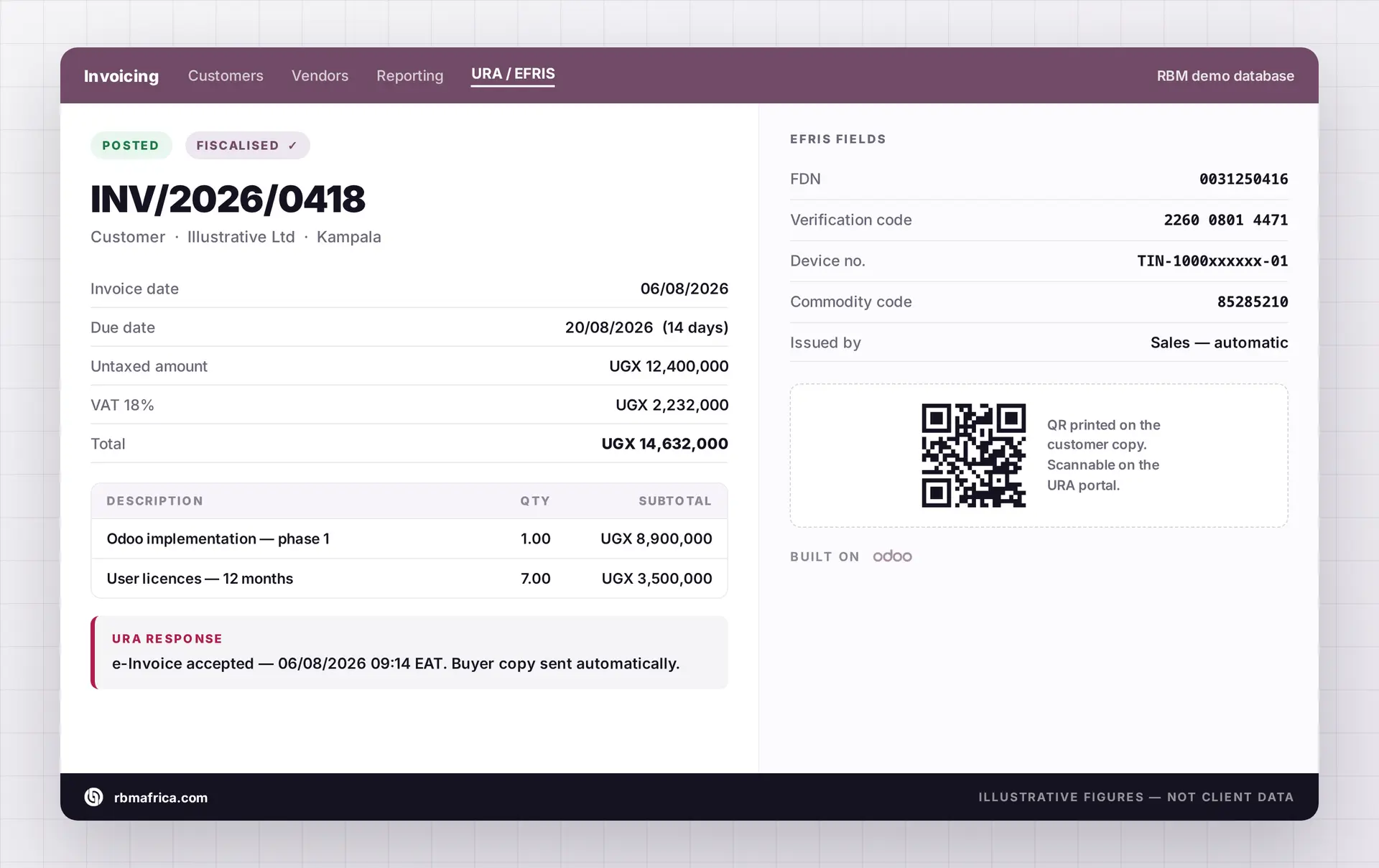
(Figures shown above are illustrative — not a client's data.)
The fix is not more discipline - It is removing the second entry. When your invoicing system talks to EFRIS directly, one action does everything: the salesperson confirms the invoice, the system sends it to URA, URA returns the FDN and verification code, and those land on the customer's copy along with the QR code - automatically, in seconds. Nobody logs into a portal. Nobody retypes anything. Your books and URA's records cannot drift apart, because they are fed by the same event.
Two practical points we get asked about constantly: "Our internet cuts!" EFRIS is designed for that. URA's own tools operate offline for up to five days and transmit when the connection returns. Power and network are a reason to plan, not a reason to stay manual.
"We'll add an EFRIS bolt-on to what we already have." You can. Just understand what you are buying: a bridge between two systems that still need to be kept in step. It solves the typing; it does not solve the drift. If your accounting system is already due for replacement, doing both at once is usually cheaper than doing them a year apart.
Five things worth doing this month

- Confirm your sector. Read the twelve categories against what you actually do, not against what your trading licence says. If you're borderline, ask your tax adviser in writing.
- Check you are active, not just registered. Log in and look at the last 30 days. Registered-but-silent is the most exposed position there is.
- Reconcile one month. Take July. Count the invoices you issued. Count the ones on EFRIS. If those two numbers differ, you have your answer about whether double entry is working.
- Check what your suppliers send you. Your deduction depends on their compliance. Any supplier in the twelve sectors who is still sending you a plain invoice is a "cost you are carrying."
- Decide once, properly. Bolt-on or integrated system - either is defensible. Doing nothing for another quarter is not.
One question, and we'll answer it...

We would rather write about what you're actually stuck on than what we assume. Reply or comment with the one EFRIS or bookkeeping question that keeps coming back in your business. We'll answer the most common one in full in the next edition - no names, no sales pitch.
If you'd rather ask privately: e-mail: sales@rbmafrica.com or +256 758 726 459.
The Back Office is published monthly by RBM Enterprise Solutions Ltd, a Kampala-based Odoo Ready Partner. We implement, customise, migrate and support Odoo ERP and QuickBooks for businesses across East Africa. Quality with Passion! This is general information about published tax rules, not tax advice. Confirm your own position with your tax adviser or URA.